hourlong learnings #9: creatine benefits and common myths
In the following post I try to understand whether creatine causes hair loss, why its muscle effects plateau, whether the newer forms are actually important to those who take it regularly, and how much of the neurological hype is grounded w clinical human evidence
Creatine is not a steroid and it does not create energy from nothing. It is a small nitrogen-containing compound that helps buffer rapid ATP demand through the creatine–phosphocreatine system. That basic chemistry explains why its strongest evidence is for repeated high-intensity work, and why several much bigger claims need a separate evidence check.
as usual, a basic thought map is below:
$$ \text{oral creatine dose} \rightarrow \text{muscle and some brain creatine uptake} \rightarrow \text{phosphocreatine buffer} \rightarrow \text{faster ATP resynthesis during demand} \rightarrow \text{performance or clinical outcome} $$
The swallowed grams are not the response. Absorption, baseline stores, tissue uptake, training, diet, and the task determine exposure and outcome. A full muscle creatine pool does not imply a full brain pool, and a plausible energy mechanism does not make a neurological treatment established.
1. mechanism and importance to ATP
ATP is the immediate chemical currency for contraction and cellular work. When ATP loses phosphate, it becomes ADP. Phosphocreatine (PCr) can donate a phosphate back through creatine kinase:
$$ \mathrm{PCr} + \mathrm{ADP} \rightleftharpoons \mathrm{ATP} + \mathrm{Cr} $$
PCr and ADP are the inputs; ATP and free creatine are the outputs. This reaction helps retain ATP when demand rises faster than other pathways can replenish it, especially over short, repeated, intense efforts.
Humans make creatine from amino-acid precursors, mainly in the kidney and liver, and obtain some from animal foods. Skeletal muscle contains most body creatine, but brain and other high-energy tissues use the same shuttle. Supplements raise total muscle creatine and PCr, leaving a larger rapidly available buffer between hard efforts.
2. the saturation curve
Muscle storage has a ceiling. The relationship is better represented as a saturating curve than a linear one:
$$ \text{store filling} \approx \frac{\text{dose exposure}}{\text{dose exposure}+K} $$
The numerator is cumulative absorbed creatine; $K$ is the rough exposure at which the curve is half-full. Early doses produce more storage change when baseline stores are low. As stores fill, each extra gram has less room to add. uptake differs with muscle mass, diet, transporter biology, and measurement method.
That curve explains two standard protocols:
| Strategy | Typical protocol | What changes |
|---|---|---|
| loading, then maintenance | about $0.3\ \mathrm{g/kg/day}$ for 5–7 days, then $3–5\ \mathrm{g/day}$ | reaches near-saturation faster |
| daily maintenance only | $3–5\ \mathrm{g/day}$ | reaches a similar plateau more gradually, often over roughly 3–4 weeks |
Loading changes time to saturation, not the eventual identity of the molecule. It can also create more early water-weight gain and gastrointestinal discomfort because more powder is taken at once.
3. the best-supported benefits are narrow
Creatine monohydrate has the strongest evidence for increasing high-intensity exercise capacity and, when paired with resistance training, helping gains in strength and lean mass. The likely pathway is not that it directly builds muscle protein; it lets some people perform or recover from a little more high-quality work over many sessions, then training adaptation does the rest.
creatine stores rise
→ repeated hard work is slightly better supported
→ training volume or quality can increase
→ strength and lean-mass adaptations accumulate
Water follows intracellular solutes, so early scale weight and lean-mass measurements can rise before structural muscle growth. Calling all lean-mass gain “water” is too dismissive but on the other hand calling all of it new contractile tissue is too conclusive and disproven in a 2001 cohort study EPGS et al
4. monohydrate is the ideal form
| Form | What is actually established | Practical read |
|---|---|---|
| creatine monohydrate | most human efficacy, safety, uptake, and performance data | default comparator |
| micronized monohydrate | smaller particles, usually easier mixing | same molecule; mixing is not superior biology |
| creatine HCl | more soluble in water | insufficient evidence that it outperforms monohydrate at a lower dose |
| buffered / alkaline forms | marketing claims about stability | no convincing advantage in muscle retention or performance |
| ethyl ester | studied enough to test the claim | not superior; some work suggests poorer conversion/retention than monohydrate |
| nitrate, citrate, malate, magnesium chelate | some limited studies | not enough head-to-head evidence to displace monohydrate |
The useful distinction is solubility versus efficacy. A powder can dissolve more easily and still not deliver more creatine to muscle or improve outcomes more. The 2022 systematic review of alternative forms found far less data than the market implies; the critical review literature still identifies monohydrate as the form with the clearest established efficacy and safety
5. creatine and hair loss
The hair-loss worry is not completely imagined, but it’s a conclusion drawn upon on a very small evidence base. A 2009 crossover study in 20 male rugby players used a large loading protocol—$25\ \mathrm{g/day}$ creatine plus $25\ \mathrm{g/day}$ glucose for 7 days, then $5\ \mathrm{g/day}$ for 14 days—and reported higher serum DHT and DHT:testosterone ratio. It did not measure hair count, density, follicle diameter, or clinical hair loss.
DHT matters in androgenetic alopecia because susceptible follicles respond to it by miniaturizing over time. But this chain has several links:
creatine dose
→ circulating DHT or local follicle androgen signaling
→ susceptible follicle response
→ repeated growth-cycle change
→ visible hair loss
The 2009 study only addressed one possible intermediate signal, in 20 athletes, for three weeks. A serum hormone change also is not automatically a scalp-follicle exposure or an alopecia outcome.
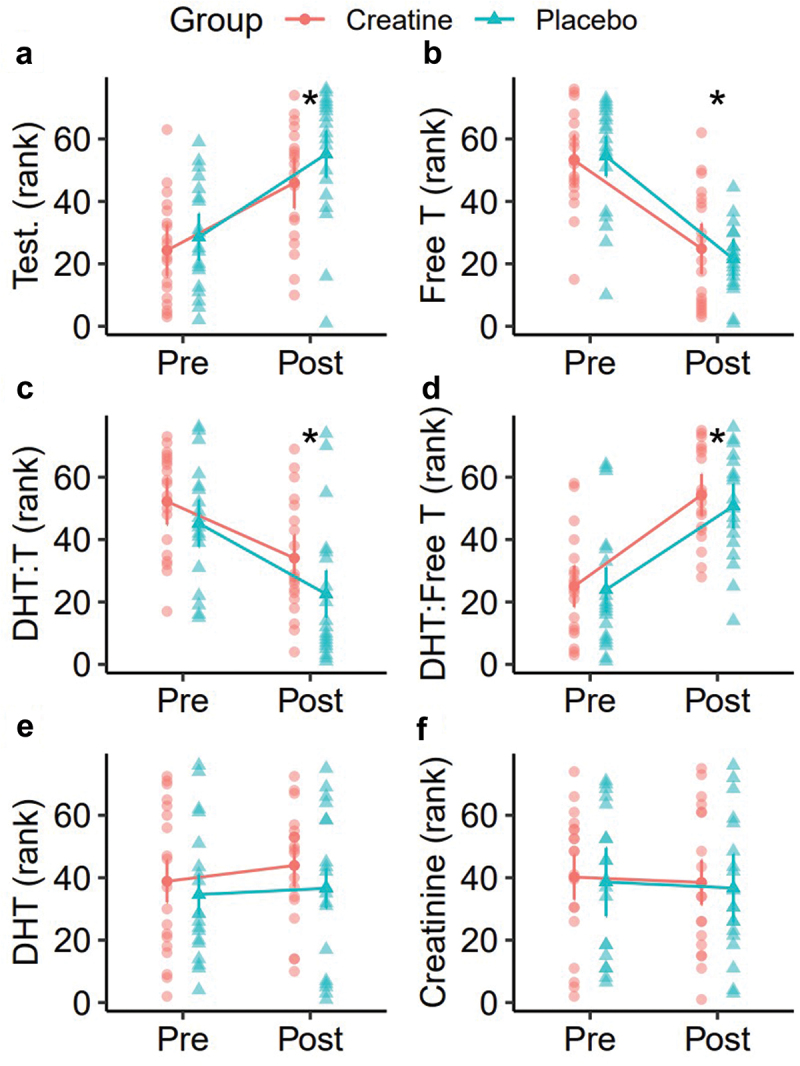
The more recent trial measured the intermediate hormone claim directly. Its rank-based graph shows DHT, testosterone, and the relevant ratios before and after 12 weeks; there was no creatine-specific group-by-time difference.
6. 2025 direct hair trial
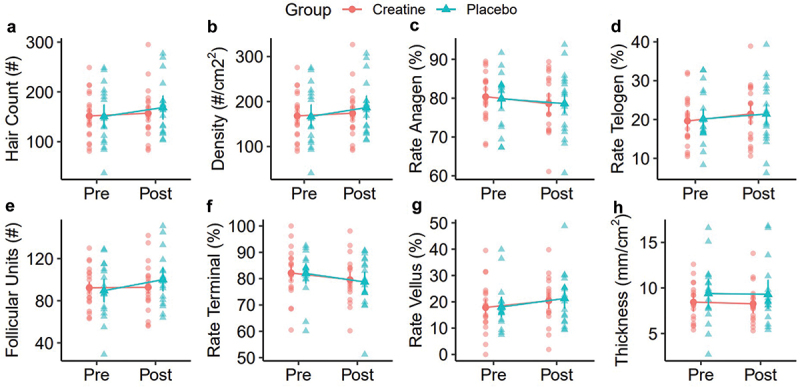
in a 2025 double-blind randomized trial, 45 resistance-trained men aged 18–40 were assigned to $5\ \mathrm{g/day}$ creatine monohydrate or $5\ \mathrm{g/day}$ maltodextrin for 12 weeks; 38 completed the trial. Researchers measured total and free testosterone, DHT, DHT:testosterone ratio, and multiple hair outcomes including count, density, growth-phase distribution, follicular-unit count, and cumulative thickness. They reported no creatine-versus-placebo difference in DHT, the ratio, or the hair measures.
The hair-outcome figure shows the individual and group changes rather than an anecdote about shedding.
The same cohort also re-ran the hair analysis with rank-based statistics, a useful robustness check when individual measurements aren’t normally distributed and cant be quantiled
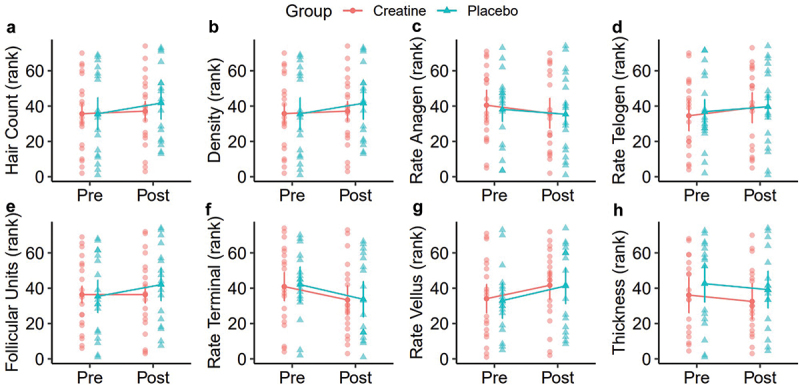
this is super strong evidence against the common claim that ordinary $5\ \mathrm{g/day}$ creatine actually causes hair loss in this population over 12 weeks. It is not proof of no possible effect in every genetically susceptible person, at every dose, or over years
The study did not enroll women, establish family hair-loss history, or measure scalp androgen but for a shorter term study still had strong methodology according to their IRB and journal NASM submission
7. neurological benefits are plausible but not proven
The brain has high ATP turnover, PCr, creatine kinase, and creatine transport. Human magnetic-resonance studies suggest oral supplementation can raise brain creatine, but generally less dramatically and less predictably than muscle stores. Crossing a mechanistic boundary—blood to brain—therefore makes dosing and outcomes harder to infer from gym studies.
There are at least four different neurological questions that are often collapsed into “creatine is good for the brain”:
| Question | Current human evidence | What it does not establish |
|---|---|---|
| cognition in healthy adults | small, mixed effects; some meta-analyses find modest memory or processing-speed signals | a reliable nootropic effect for every healthy person |
| sleep deprivation / high cognitive stress | a more plausible subgroup signal, with some small studies | routine long-term cognitive enhancement |
| depression adjunct treatment | interesting trials, but a 2025 meta-analysis rated the evidence very low certainty and the average symptom effect below the usual minimal important difference | an alternative to depression care |
| neurodegenerative disease, TBI, stroke, Alzheimer’s disease | feasibility work, pilot studies, animal models, and biological rationale | established prevention or treatment |
A 2024 meta-analysis of 16 RCTs and 492 participants found small benefits for memory ($\mathrm{SMD}=0.31$) and attention time, no significant effect on overall cognition or executive function, and low certainty for several outcomes. A separate 2024 systematic review concluded that brain creatine can increase while cognitive results remain equivocal. Both observations can coexist: changing a metabolite is not the same thing as changing a meaningful clinical endpoint.
8. a successful pilot that could be a future of treatment
An 8-week open-label Alzheimer’s pilot found brain total creatine rose on magnetic-resonance spectroscopy and some cognitive measures improved. That is exciting as an exposure study: it demonstrates that a high-dose protocol can move the intended brain measurement in that particular cohort.
however, without a placebo comparison, expectations, test familiarity, concurrent care, and natural variation can all mimic the observed cognitive improvement. The better next study is a masked randomized trial that measures brain creatine, prespecifies clinically meaningful cognitive and functional metrics, and follows people long enough to separate a test-retest effect from disease modification.
The claim that survives is narrow: creatine is a credible brain-energy intervention worth testing in defined settings. It is not currently a general neurological therapy.
9. dose, timing, and safety
For a healthy adult pursuing the best-supported exercise goal, plain monohydrate at $3–5\ \mathrm{g/day}$ is the evidence-matched baseline. The exact hour is not known to be decisive; adherence across days is more important than a post-workout ritual. Taking it with a meal can be reasonable if that improves consistency or stomach comfort.
Creatine can raise serum creatinine because creatinine is a breakdown product of creatine. That can complicate the interpretation of a creatinine-based kidney estimate without demonstrating kidney damage. anyone with kidney disease, a complex medical condition, pregnancy, or medicines that affect renal function should have clinician guidance
The common short-term adverse effects are usually GI upset with larger doses and body-mass gain from water retention. A supplement is also a supply-chain object: third-party testing and a single-ingredient product reduce the avoidable uncertainty from contamination or undisclosed extras.
TLDR. creatine’s strongest effects make sense once I start thinking of it as a finite ATP buffer. The saturation curve makes the dose logic much easier to understand, and monohydrate wins mostly because it has been tested the most, not because it necessarily is any more advanced than other forms. The hair-loss fear has one plausible intermediate study but no direct outcome evidence until the recent 12-week trial, which found no evidence of causation. For the brain, it’s important to know that while the potential mechanism is proven to be real, most of the potential clinical implementations are still under research
Comments are closed for this post.